" height="19.593489627012634px" id="HZMnoshln" transform="translate(35.667 1.777)" width="65.54152709402429px"/><path d="M 0 0.017 C 2.315 0.103 4.878 -0.071 7.193 0.036 C 7.468 0.279 12.481 5.793 12.556 5.958 C 11.717 6.005 10.736 5.956 9.888 5.958 C 8.409 5.961 6.923 5.977 5.446 5.957 C 4.793 5.44 4.259 4.69 3.684 4.077 L 1.651 1.879 C 1.049 1.235 0.525 0.741 0 0.017 Z" fill="rgb(12, 241, 145)" height="5.978734113643265px" id="B_ZyWaY8J" transform="translate(12.847 17.922)" width="12.556331656472807px"/><path d="M 18.85 0 L 25.936 0 C 24.823 1.198 23.694 2.514 22.583 3.726 L 11.098 16.3 L 7.002 20.802 C 6.307 21.56 5.61 22.392 4.847 23.07 C 3.802 23.997 1.958 23.832 0.982 22.861 C 0.429 22.31 0.203 21.736 0 20.995 L 0 4.033 C 0.736 4.729 1.513 5.612 2.204 6.369 L 5.127 9.559 C 5.157 10.119 5.127 10.896 5.126 11.475 C 5.128 12.703 5.12 13.932 5.101 15.16 C 5.602 14.614 6.075 14.035 6.574 13.485 L 11.831 7.736 C 14.119 5.193 16.502 2.478 18.85 0 Z M 60.302 6.916 C 61.496 6.907 62.723 6.937 63.927 6.935 C 62.687 10.72 61.245 14.453 59.866 18.186 C 59.324 19.656 58.713 21.843 58.009 23.157 C 57.54 24.036 56.936 24.913 56.037 25.37 C 55.493 25.647 54.887 25.798 54.297 25.935 L 52.098 25.935 C 51.91 25.715 52.001 23.361 51.992 22.874 C 54.16 22.932 54.67 22.721 55.309 20.461 L 52.023 11.377 C 51.506 9.944 50.881 8.391 50.444 6.937 C 51.689 6.941 52.935 6.933 54.181 6.913 C 54.393 7.343 54.775 8.624 54.941 9.14 C 55.392 10.543 55.864 11.949 56.361 13.336 C 56.62 14.057 56.993 15.495 57.285 16.127 C 57.802 14.421 58.424 12.752 58.95 11.029 C 59.213 10.164 59.955 7.668 60.302 6.917 Z" fill="rgb(255, 255, 255)" height="25.9350729038176px" id="RJr52Ozxy" width="63.92682320478577px"/></g></svg>)
Bulgaria runs its company data through a single portal, the Commercial Register and Register of Non-Profit Legal Entities, administered by the Registry Agency. The English interface exists, but the translation is rough, and the two search functions you need are named in ways that hide what they do. What follows is what we found when we accessed Bulgaria’s Commercial Register on 23 July 2026.
What Is the Bulgarian Commercial Register?
The Commercial Register (Targovski Registar) is the official source for company registry data in Bulgaria.
It sits on the same Registry Agency platform as the Register of Non-Profit Legal Entities and the BULSTAT Register, which covers trusts, foreign branches, and other arrangements.
Beneficial ownership data is not held in a separate database but is embedded directly into each entity's electronic file.
What Data Is Available?
The public record for a single entity is detailed. Working from a live company file, the fields returned include:
Basic: UIC/PIC (the unique identifying code), company name, transcription of the name in a foreign language, legal form, registered office and head office address, and scope of business activity.
Officers: Managers by full name and country, plus the manner of representation (jointly, severally, or both).
Ownership: Shareholders (listed as “partners”) by name, country, and portion of shareholding, stated as a capital amount, as well as beneficial owners by name, country of residence, and percentage of holding.
Financial: Assets, prepaid expenses, equity and liabilities, net sales revenue, other income, costs of raw materials, materials, and external services, staff costs, depreciation and impairment, and other expenses.
Each field carries a timestamp tied to the filing that entered or last changed it, so you can see when a record was created and when it was amended.
Which Entities Must Register?
The Commercial Register records all commercial entities operating in Bulgaria. The main forms are:
OOD (limited liability company): Two or more owners, limited liability. The most common corporate form. Minimum capital is nominal, set at around €1 following euro adoption.
EOOD (single-member limited liability company): The same framework for a sole owner.
AD (joint-stock company): For larger ventures and public share issuance, with a board and a substantially higher minimum capital (around €25,500).
EAD (single-member joint-stock company): The single-shareholder version of the AD.
ET (sole trader): A sole proprietorship with unlimited personal liability.
SD and KD (general and limited partnerships): Less common, used for specific structures.
Branches of foreign companies: Registered but not separate legal persons; liability runs to the parent.
The OOD and EOOD are what you will see most often. Both are limited liability vehicles with named partners and stated shareholding, so the ownership layer is usually visible on the public record. The AD is where ownership becomes harder to trace, because shareholders in a joint-stock company are not all disclosed in the same way.
How to Search the Commercial Register
Step 1: Go to the Registry Agency Portal
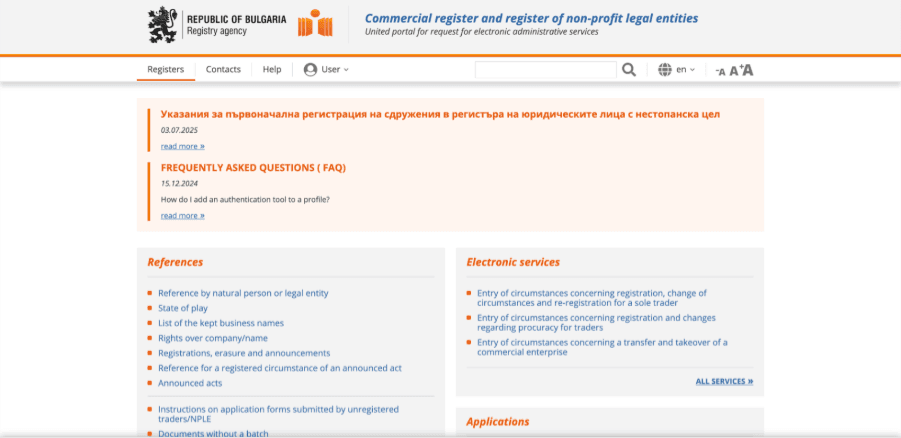
The portal is at portal.registryagency.bg.Switch the interface to English using the language toggle, but treat the translation with caution. The labels do not always describe what the function does, and two of them matter for search.
Step 2: Choose the right search function
Two functions under "References" do the searching, and their translated names are not rendered correctly. "Reference by natural person or legal entity" shows the links between a person or entity and other entities. "State of Play" is the legal entity search, and it only accepts the UIC identifier. If you have a name but no number, start with the first function, because "State of Play" cannot search on a name.
Step 3: Search by name in Cyrillic
The register searches in Cyrillic. To look up a person by a common name, you must render it in Cyrillic script first. When we searched for the forename "Georgi" on 23 July 2026, we had to enter it as "Георги". Expect volume: that single common forename returned 46,826 results, each one an accordion you expand individually. Some rows resolved to named individuals linked to entities; others returned "No data".
Step 4: Open the entity record
Once you reach a legal entity through "State of Play", the record opens under "Total Status" listing the main circumstances: UIC, name, legal form, office, activity, managers, representation, and partners with their shareholding. A blue button next to each field shows the history of changes, with the date and time each change was made. A green button shows the documents filed for that entry.
Step 5: Download what is public
Two document types are open to everyone: a photocopied annual financial report and the articles of association (the current act of establishment). Both are scanned images of the originals, in Bulgarian, and some scans are blurry. Everything else behind the green button is gated.
Step 6: The access wall
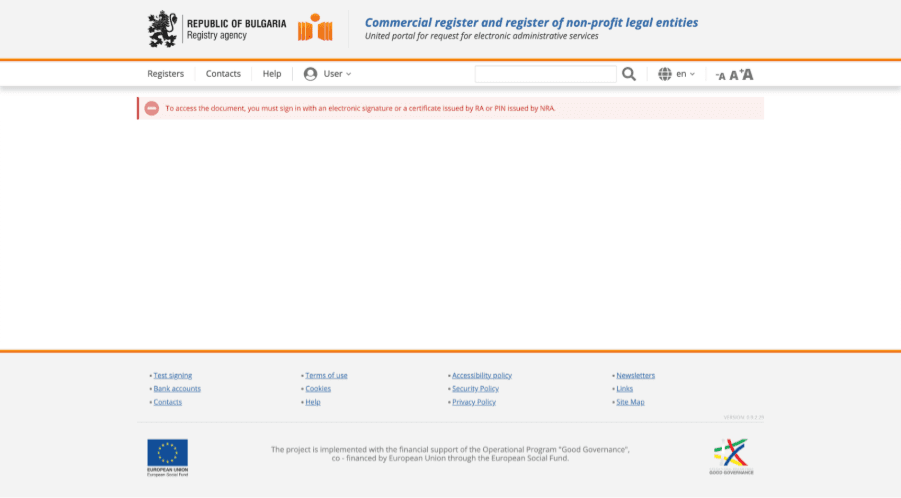
Sections such as "Case" (the amendment of irregularities) and "Instructions" are not readable without authentication. When we tried to open them, the portal returned a fixed message: ‘to access the document, you must sign in with an electronic signature or a certificate issued by the Registry Agency, or a PIN issued by the National Revenue Agency.”
In practice, this means the deeper record is closed to anyone without Bulgarian or EU digital credentials and possibly closed further to anyone not verified as acting on the entity's behalf.
Available Documents
All documents are available in Bulgarian.
Annual financial report (free): Assets, prepaid expenses, equity and liabilities, net sales revenue, other income, costs of raw materials, materials, and external services, staff costs, depreciation and impairment, and other expenses. Remember: this is a scanned photocopy.
Articles of association / current act of establishment (free): The company's constitutive rules, again as a scanned image.
Certificates: 5.00 BGN for the first page and 2.00 BGN for each additional page. An electronic certificate costs 2.50 BGN for the first page and 1.50 BGN for each additional page. At the fixed rate of 1.95583 lev to the euro, the electronic first page works out to roughly €1.30.
Documents under "Case" and "Instructions" (gated): require an electronic signature, a Registry Agency certificate, or an NRA PIN.
APIs and Open Data
The Registry Agency sells access to the full Commercial Register database through a SOAP-based web service with an XML schema. This means, if you’re running a RESTful API, this data must be normalised (KYB data providers like Kyckr handle this for you).
Access is by subscription. According to this tariff extract, the fee is a flat 100 BGN per year, roughly €51 at the fixed rate of 1.95583 lev to the euro. That is the figure on the tariff extract we checked on 23 July 2026.
Beneficial Ownership Register
Bulgaria does not run a standalone beneficial ownership database. Under MAMLA, UBO records live inside each entity's electronic file.
On 23 July 2026, the Kyckr team was able to access beneficial ownership data without proving a legitimate interest, including names, percentages and country of residence.
Accessing the sensitive detail – exact residential address, personal identification number (EGN for residents, date of birth for non-residents), and scanned certified documents – requires formal authentication. That means a Qualified Electronic Signature recognised under eIDAS, a Personal Identification Code issued to Bulgarian residents, or a physical Registry Agency certificate obtained in person.
2025–2026 Reforms
Bulgaria's registry framework changed across 2025 and 2026.
1. Euro adoption
After Bulgaria adopted the euro in January 2026, registered share capital was converted to euros, and company files now display capital in euros, as the live records confirm.
Existing companies must reflect the redenominated capital in their articles of association and file the update with the Commercial Register by 31 December 2026. For anyone reading capital figures, the currency on older filings will differ from current ones, so check the timestamp before comparing.
2. Register of Persons Deprived of Management Rights
A new non-public register, established under the Law on the Commercial Register (State Gazette No. 87 of 2025), lists individuals barred from serving as directors or board members, including personal bankrupts and former managers of companies dissolved through bankruptcy with unsatisfied creditors. Access is limited to courts, the prosecutor's office, SANS, the Bulgarian National Bank, the Financial Supervision Commission, and nationally regulated AML authorities. A proposal to give lawyers access was rejected. Registration officials must check this register before approving a new appointment, but you cannot query it yourself, so confirming a director's eligibility now depends on the Agency's internal verification.
3. Public register of company service providers
Entities that sell registered and correspondence addresses, business accommodation, company-incorporation help, and secretarial services must enter a public register at the Ministry of Justice and disclose their identity, registered address, and activities.
Access Structured Bulgaria KYB Data Instantly
The Bulgarian Commercial Register offers detailed, timestamped company and ownership data. The obstacles are practical: a rough English translation, two confusingly named search functions, Cyrillic-only name search, photocopied financials, and an authentication wall that requires Bulgarian or EU digital credentials for the deeper record.
Kyckr connects directly to the register and delivers live company data and official documents in structured form, without the electronic signature or in-person certificate the portal demands. Book a demo to find out more.